
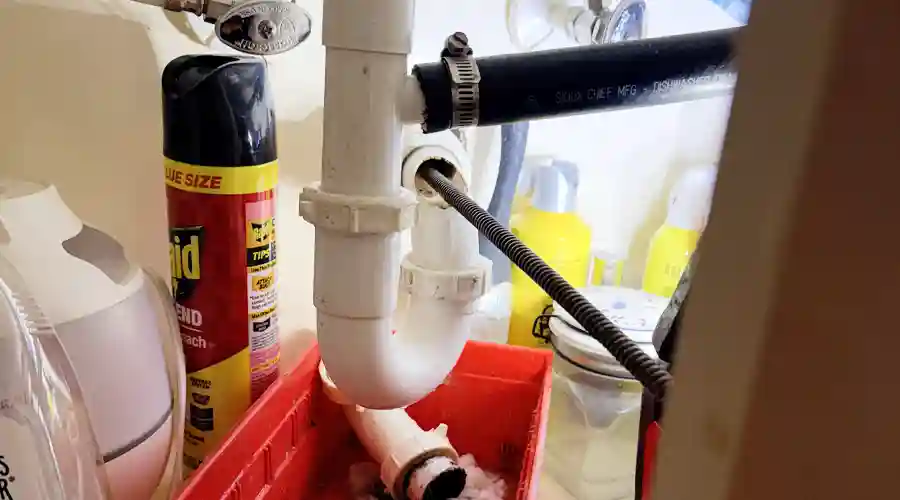
A kitchen sink takes longer and longer to empty.
The shower starts holding water around your feet.
Then one morning the toilet gurgles when the washing machine drains.
At that point, most homeowners start wondering two things:
How bad is the clog?
and
How much is drain cleaning going to cost?
There isn’t one flat drain cleaning price that applies to every Houston home.
A plumber clearing hair from a bathroom drain is dealing with a completely different problem than a main sewer line packed with roots, grease, wipes, or debris forty feet away from the house.
The most important question isn’t simply:
“How much does drain cleaning cost?”
It’s:
“What is actually blocking the pipe?”
Here’s what affects the cost of professional drain cleaning in Houston, when a simple cleaning may solve the problem, and when a recurring clog is warning you about something larger.
What Determines the Cost of Drain Cleaning?
Several factors affect the amount of work required to clear a drain.
The biggest ones are:
- Which drain is clogged
- How far the blockage is from the fixture
- Whether one or multiple fixtures are affected
- What is causing the clog
- How accessible the drain is
- Which equipment is required
- Whether the pipe itself is damaged
A simple blockage close to a sink may be relatively straightforward.
A blockage in the main sewer line can require considerably more diagnostic work.
1. Which Drain Is Clogged?
The location of the symptoms tells us a lot.
One Sink Is Clogged
If only one bathroom or kitchen sink is affected while everything else drains normally, the blockage may be close to that fixture.
Common causes include:
- Hair
- Soap
- Toothpaste
- Grease
- Food
- Small objects
These are generally different from whole-house sewer problems.
One Shower or Tub Is Slow
Hair and soap buildup are common causes.
The blockage may form gradually until the drain becomes noticeably slow.
Multiple Fixtures Are Slow
This deserves more attention.
If several drains begin slowing down at approximately the same time, the problem may be farther downstream.
For example:
- Toilet + bathtub
- Multiple bathrooms
- Kitchen + laundry
- Several toilets
can indicate a larger branch drain or main sewer restriction.
That changes both the diagnosis and the work required.
2. Where the Clog Is Located
A blockage two feet below a sink is not the same as one fifty feet into a sewer line.
The farther the obstruction is from an accessible cleanout or fixture, the more difficult it may be to reach.
This is why a plumber may ask questions such as:
- Which fixtures are affected?
- Did the problem start suddenly?
- Does flushing one toilet affect another drain?
- Is there an exterior cleanout?
- Has the sewer clogged before?
Those questions help narrow down where the obstruction may be located before equipment is used.
3. What Is Causing the Blockage?
Different materials behave differently inside a drain.
Common causes include:
Hair
Bathroom sinks, tubs, and showers frequently collect hair.
Hair mixes with soap and other residue until it creates a dense obstruction.
Grease
Kitchen grease can coat the inside of a drain.
As more material sticks to it, the opening becomes smaller.
Eventually food particles and debris can create a complete blockage.
Food Waste
Garbage disposals can encourage homeowners to put more material down a kitchen drain than the plumbing can handle.
Fibrous foods, grease, starches, coffee grounds, and other debris can contribute to recurring blockages.
If your disposal is humming, leaking, or not draining properly, see our guide to common garbage disposal problems in Houston.
Flushable Wipes
The word flushable doesn’t mean a wipe behaves like toilet paper once it enters your sewer.
Wipes tend to remain intact much longer.
They can catch on:
- Roots
- Rough pipe surfaces
- Offset joints
- Existing debris
and create increasingly large obstructions.
We explain why in our guide to flushable wipes and Houston sewer clogs.
Tree Roots
Roots are different.
They usually don’t enter a perfectly sealed sewer pipe.
They find openings around:
- Cracks
- Failed joints
- Separated connections
Once inside, they grow toward the moisture and catch waste moving through the pipe.
Removing roots may restore flow.
But if the opening remains, the roots can eventually return.
Houston’s mature trees make this particularly relevant in older neighborhoods.
See our guide to tree roots in Houston sewer lines for more detail.
4. Whether the Problem Is a Drain or the Main Sewer
This is one of the biggest differences in drain-cleaning jobs.
A homeowner may say:
“My shower is clogged.”
But if the toilet also gurgles and another bathroom backs up, the shower may simply be the lowest place where a main sewer blockage is becoming visible.
Local Drain Problem
Usually affects one fixture or one small group of nearby fixtures.
Main Sewer Problem
May affect:
- Multiple toilets
- Showers
- Bathtubs
- Floor drains
- Multiple rooms
If wastewater is backing up through several fixtures, stop using the plumbing until the blockage is diagnosed.
Continuing to run water can turn a slow drain into a sewage backup.
Professional Drain Cleaning vs. DIY
Not every clog requires a plumber.
Some simple fixture clogs can be handled safely at home.
You may be able to try:
- Removing visible hair
- Cleaning the stopper
- Using a plunger
- Cleaning a removable trap when appropriate
But DIY methods have limits.
If the clog is deeper, keeps returning, or affects multiple fixtures, repeatedly treating the symptom can waste time without addressing the cause.
What About Chemical Drain Cleaners?
Chemical drain cleaners are popular because they’re easy to buy.
But they’re not a universal solution.
They may be ineffective against:
- Tree roots
- Large grease obstructions
- Foreign objects
- Pipe damage
- Main sewer problems
- Significant buildup
And when the chemical doesn’t work, it remains inside the backed-up plumbing.
That matters because the next person opening the drain or working with equipment may be exposed to it.
For recurring or severe clogs, diagnosing the line is usually more useful than adding another bottle of chemicals.
What Does Professional Drain Cleaning Actually Do?
Professional drain cleaning is intended to remove the obstruction and restore proper flow.
Depending on the situation, a plumber may use different equipment.
The exact method depends on:
- Pipe size
- Drain location
- Type of blockage
- Access
- Condition of the plumbing
The objective is not simply to punch a tiny hole through the clog.
Ideally, the pipe should be flowing properly again and the reason for the obstruction should be understood.
Hugo Plumbing provides professional drain cleaning in Houston for clogged sinks, tubs, showers, toilets, branch drains, and larger drainage problems.
Why Does the Same Drain Keep Clogging?
A clog that happens once can be normal.
The same drain clogging repeatedly deserves more attention.
Possible causes include:
- Heavy grease accumulation
- Hair buildup
- Wipes
- Roots
- Pipe scale
- Improper slope
- Offset joints
- Sagging pipe
- Structural damage
Imagine clearing tree roots from a sewer line without repairing the opening where those roots entered.
Flow is restored.
But the underlying condition still exists.
The same thing can happen when a pipe has a belly or offset joint that catches debris.
The cleaning worked.
It simply didn’t change the pipe.
When Drain Cleaning Is Probably Enough
Drain cleaning may be all you need when:
- The blockage is isolated
- The pipe is structurally healthy
- The clog is caused by normal buildup
- The problem does not immediately return
- Other fixtures drain normally
- There are no signs of pipe damage
For example, a heavily clogged kitchen branch may simply need a thorough cleaning.
When Drain Cleaning May Not Be Enough
Pay attention when you have:
Recurring Backups
If the same problem comes back shortly after professional cleaning, something may be causing the obstruction to reform.
Multiple Fixtures Backing Up
This suggests a deeper blockage.
Tree Roots
Roots can indicate that the pipe has an opening or failed connection.
Standing Water Seen During Inspection
Sewer pipes are supposed to maintain slope.
Standing water can indicate a low section or belly.
Visible Pipe Damage
Cleaning cannot repair:
- Cracks
- Collapsed pipe
- Broken joints
- Major offsets
At that point, the problem moves from drain cleaning toward sewer line repair.
Drain Cleaning vs. Sewer Line Repair
These services solve two different problems.
Drain Cleaning
Removes material that is obstructing flow.
Examples:
- Hair
- Grease
- Waste
- Wipes
- Debris
- Certain root intrusion
Sewer Line Repair
Corrects physical problems with the pipe.
Examples:
- Cracks
- Breaks
- Collapses
- Separated joints
- Severe offsets
- Damaged pipe sections
A clogged sewer doesn’t automatically need replacement.
And a broken sewer isn’t permanently fixed just because a cleaning machine temporarily restores flow.
Diagnosis matters.
Warning Signs the Clog May Be in the Main Sewer Line
Watch for:
- Multiple drains slowing simultaneously
- Toilet gurgling
- Water rising in a tub when a toilet flushes
- Sewage odors
- Backups in the lowest drain
- Repeated whole-house clogs
- Sewage appearing outside
- Problems returning after cleaning
If you’re seeing several of these symptoms, read our guide to the warning signs of a sewer line problem in Houston.
Can Hard Water Contribute to Drain Problems?
Houston water contains dissolved minerals.
Mineral deposits are generally discussed more often in relation to:
- Fixtures
- Water heaters
- Supply piping
but buildup can also contribute to rough surfaces and narrowing in certain plumbing systems over time.
A rough or restricted pipe can catch material more easily than a clean, smooth one.
We’ve covered Houston’s water conditions in our guide to hard water and plumbing damage.
Why Kitchen Drains Clog So Often
Kitchen drains deal with a combination of materials that other drains don’t.
These include:
- Grease
- Oils
- Food
- Soap
- Starch
- Coffee grounds
- Disposal waste
Grease is particularly troublesome.
It may enter the drain warm and liquid.
Then it cools inside the piping.
Once it begins coating the pipe, additional debris sticks to it.
This buildup can happen slowly enough that homeowners don’t notice until the sink becomes extremely slow.
If you’re currently dealing with one, our Houston clogged kitchen sink guide covers some safe first steps.
Why Bathroom Drains Clog
Bathroom drains usually face a different combination:
- Hair
- Soap
- Toothpaste
- Skin products
- Shaving products
Hair is particularly effective at catching other material.
A small amount around a stopper can gradually become a dense blockage deeper in the drain.
Is a Slow Drain an Emergency?
Usually not.
One slow sink with no water damage can generally be scheduled for service.
But there are exceptions.
Treat the problem more urgently when:
- Sewage is backing up
- Multiple fixtures stop draining
- A toilet is overflowing uncontrollably
- Wastewater is entering the home
- The backup creates a sanitation issue
For a broader explanation, see our guide to what counts as a plumbing emergency in Houston.
How to Prevent Drain Clogs
No home will avoid every clog forever.
But several habits make a major difference.
Keep Grease Out of the Kitchen Sink
Let cooking grease cool and dispose of it separately.
Don’t Flush Wipes
Even products labeled flushable can contribute to sewer problems.
Use Drain Screens
Simple screens can catch hair before it enters shower and tub drains.
Be Careful With Garbage Disposals
A disposal isn’t a trash can.
Small amounts of appropriate food waste are very different from stuffing large amounts of debris through the drain.
Pay Attention to Slow Drains
A drain rarely goes from perfect to completely blocked without giving some warning.
Slow drainage is often the first clue.
Questions to Ask When a Drain Keeps Clogging
If you’ve already paid to have a drain cleaned and the problem keeps returning, ask:
- Where was the blockage?
- What material was removed?
- Was the clog close to the fixture?
- Was it in the main sewer?
- Were roots present?
- Is there evidence of pipe damage?
- Would inspection help determine why it keeps happening?
- Are multiple drains connected to the affected line?
The objective isn’t simply to keep clearing the same clog.
It’s to understand why it keeps forming.
How Hugo Plumbing Handles Drain Problems
Not every clogged drain needs an expensive repair.
Sometimes the correct solution really is straightforward professional cleaning.
Other times, a drain that repeatedly backs up is the first warning sign of something deeper.
Hugo Plumbing provides drain cleaning services in Houston for clogged and slow drains throughout the home.
When the symptoms point toward a larger sewer issue, we can also evaluate whether the problem involves the main line and whether sewer line repair is actually necessary.
The objective is to recommend the repair the plumbing needs — not simply the biggest service available.
Frequently Asked Questions
How much does drain cleaning cost in Houston?
Drain cleaning costs in Houston vary depending on which drain is clogged, where the blockage is located, how difficult it is to access, the type of equipment required, and whether the problem is a simple fixture clog or a blockage in the main sewer line.
A straightforward sink or tub clog is very different from recurring backups caused by roots, damaged pipe, or a deep sewer obstruction.
Is professional drain cleaning worth it?
Professional drain cleaning can be worthwhile when plunging or simple DIY methods do not solve the problem, when a clog keeps returning, or when several fixtures are draining slowly at the same time.
The goal is not only to restore flow but also to determine whether the blockage is caused by buildup, roots, foreign material, or a damaged sewer line.
What is the difference between drain snaking and sewer line repair?
Drain snaking or cleaning removes an obstruction from inside a pipe so wastewater can flow again.
Sewer line repair addresses physical damage such as cracks, collapsed pipe, separated joints, severe root intrusion, or improper slope.
Cleaning can restore flow through a structurally healthy pipe, but it cannot permanently repair a broken sewer line.
Why does my drain keep clogging after it has been cleaned?
Recurring clogs can be caused by grease, hair, wipes, roots, scale, a poorly sloped pipe, an offset joint, or structural damage.
If the same drain repeatedly backs up after cleaning, a plumber may recommend inspecting the line to determine why the obstruction continues to form.
Should I use chemical drain cleaner before calling a plumber?
Chemical drain cleaners may not solve deeper or recurring blockages and can leave harsh chemicals inside a pipe that a plumber later has to work around.
For major backups, multiple slow drains, or clogs that keep returning, professional diagnosis is usually a better approach than repeatedly adding chemicals.
Clear the Clog — Then Find Out Why It Happened
A clogged drain doesn’t automatically mean you have a serious sewer problem.
But the same drain backing up again and again shouldn’t be treated as normal either.
If one sink is slow, the problem may be simple.
If toilets are gurgling, multiple drains are backing up, or a clog returns shortly after cleaning, there’s more reason to investigate what’s happening farther down the line.
Hugo Plumbing provides professional drain cleaning in Houston for slow drains, clogged sinks, toilets, tubs, showers, and larger drainage problems.
📞 (713) 409-7176
If Your Drain Won’t Go, Call Hugo.
If your drain won’t go, call Hugo.
Explore Our Plumbing Services
See all plumbing services, the areas we serve, or more plumbing tips.