
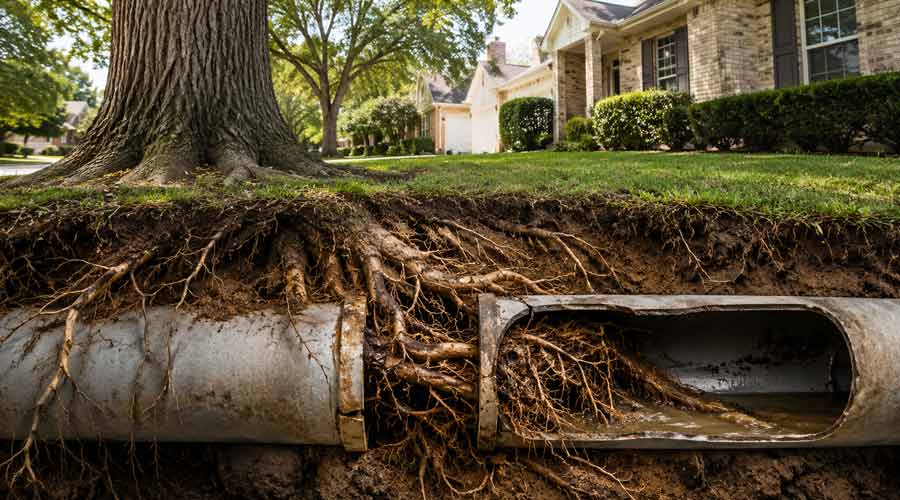
It’s August in Houston. Your yard is dry, the ground is cracking, and the trees around your house are looking for every bit of moisture they can find.
Underground, something else may be happening.
Your sewer line carries a steady supply of water beneath the yard. If that pipe has even a small crack, deteriorated joint, or opening, nearby tree roots may find it.
A tiny root entering a sewer pipe doesn’t look like an emergency.
Give it enough time, though, and that root can turn into a thick mass that catches toilet paper, grease, wipes, and waste until your sewer line barely drains at all.
Here’s how tree roots get into Houston sewer lines, the warning signs homeowners often miss, and what you can do before a slow drain turns into sewage backing up inside your home.
Why Tree Roots Grow Toward Sewer Lines
Roots need three things: water, oxygen, and nutrients.
A sewer line provides all three.
Healthy roots don’t normally smash through a brand-new, properly installed PVC sewer pipe. The problem usually begins when the pipe already has a weak point.
That might be:
- A small crack
- A separated pipe joint
- Aging cast iron
- Older clay sewer pipe
- A damaged connection
- A section shifted by soil movement
- A pipe that has begun to collapse
Moisture can escape through these tiny openings into the surrounding soil.
Roots naturally grow toward that moisture.
Once a thin root finds the opening, it enters the sewer line and suddenly has access to a nearly constant source of water and nutrients.
That’s when a tiny plumbing defect can become a much bigger problem.
Why Houston Homes Are Vulnerable
Houston gives underground plumbing a difficult combination of conditions.
Houston’s Clay Soil Moves
Much of the Houston area has expansive clay soil.
When the ground becomes saturated, clay expands.
When Houston goes through long stretches of hot, dry weather, that soil loses moisture and contracts.
You can sometimes see the effect right in your yard: deep cracks appearing in dry soil during the summer.
Your underground plumbing experiences that movement too.
Over many years, repeated expansion and contraction can place stress on buried sewer lines and their joints.
A joint that was once tight may shift slightly.
An aging pipe may crack.
Once an opening develops, roots have a way inside.
If you’ve already noticed unexplained moisture or signs of underground plumbing problems, read our guide to slab leaks in Houston.
Mature Houston Trees Need Water
Large trees can have extensive root systems stretching well beyond the visible canopy.
During hot, dry periods, those roots continue searching for moisture underground.
Your sewer line isn’t necessarily their target.
Water is.
But if moisture is escaping from a damaged sewer joint, roots may eventually find it.
Older Houston Homes Can Have Older Sewer Materials
Many established Houston neighborhoods have homes with decades-old plumbing.
Older sewer systems may include cast iron or other materials and connections that deteriorate with age.
Corrosion, shifting soil, and decades of use can create the openings roots need.
If you’re already dealing with recurring plumbing issues throughout an older house, our guide to signs your Houston home may need repiping explains some of the other warning signs to watch for.
7 Signs Tree Roots May Be Inside Your Sewer Line
Root intrusion usually doesn’t start with sewage covering the bathroom floor.
The plumbing often warns you first.
1. Multiple Drains Are Slow
One slow bathroom sink usually means a localized clog.
But when the toilet, shower, bathtub, and other fixtures begin draining slowly around the same time, start thinking farther downstream.
The restriction may be in your main sewer line.
2. Your Toilet Gurgles When the Shower Drains
This is one of the more important warning signs.
Water moving through the drainage system pushes and pulls air through the pipes.
When a main line becomes restricted, that air may escape through another fixture.
You might flush one toilet and hear another one bubble.
Or drain the bathtub and hear the toilet gurgle.
Your plumbing is telling you that water and air aren’t moving through the drainage system normally.
3. The Same Clog Keeps Coming Back
You clear the drain.
Everything works again.
Three weeks later, it’s slow.
Then it clogs again.
Recurring main-line clogs are different from dropping too much hair down one shower drain.
Something may be physically restricting the sewer line.
Roots are one possibility.
A damaged pipe, heavy buildup, or a low section of pipe can produce similar symptoms, which is why identifying the actual cause matters.
4. Several Fixtures Back Up at Once
This is where the problem becomes serious.
You flush a toilet and water appears in the bathtub.
The washing machine drains and a nearby toilet bubbles.
You run water upstairs and something backs up downstairs.
Those fixtures may all be reacting to the same downstream restriction.
Our guide to the 7 warning signs of a sewer line problem covers the other symptoms homeowners should know.
5. You Smell Sewer Gas
A properly functioning drainage system shouldn’t make your house smell like sewage.
Persistent sewer odors can have several causes, but when they’re combined with slow drains, gurgling toilets, or recurring backups, the sewer system deserves attention.
6. One Area of the Yard Is Unusually Green
Here’s the strange one.
If one strip of grass looks much greener than everything around it during a dry Houston summer, don’t automatically celebrate your landscaping skills.
A leaking underground sewer line can release moisture and nutrients into the surrounding soil.
That doesn’t automatically mean roots have damaged the pipe, but unusual vegetation directly above a sewer route is worth investigating.
7. Sewage Backs Up Into the Lowest Drain
This is the warning sign you don’t want.
When the sewer line becomes heavily restricted, wastewater has nowhere to go.
It starts looking for the lowest available opening.
That may be:
- A bathtub
- A shower
- A floor drain
- A downstairs toilet
At this point, stop running water.
Don’t start the washing machine.
Don’t take another shower.
Don’t keep flushing toilets to “see if it clears.”
You’re adding more wastewater behind an existing blockage.
Call a plumber.
How a Plumber Finds Tree Roots
The important question isn’t:
“Can we make the drain flow again?”
It’s:
“Why did it stop flowing?”
That’s where a sewer camera inspection becomes valuable.
A small waterproof camera can be sent through the sewer line to inspect the inside of the pipe.
The plumber can look for:
- Root intrusion
- Cracks
- Separated joints
- Corrosion
- Heavy buildup
- Low or sagging sections
- Foreign objects
- Partially collapsed pipe
This matters because two homes with identical slow-drain symptoms can have completely different problems.
One may need professional drain cleaning.
The other may have a broken sewer line that needs repair.
Without seeing what’s happening inside the pipe, you’re treating symptoms.
Can You Just Cut the Roots Out?
Sometimes.
If roots have entered a pipe that’s otherwise structurally usable, professional equipment may be able to remove the obstruction and restore flow.
But there’s an important distinction:
Removing the roots and repairing the sewer line are not the same thing.
Think about how the roots got there.
There was an opening.
If you remove the roots but leave that crack or failed joint exactly as it was, you’ve removed what was growing through the opening — not the opening itself.
The roots may eventually return.
That’s why recurring root problems deserve a camera inspection instead of another temporary drain clearing.
What About Chemical Root Killers?
Homeowners sometimes try chemical root treatments because they seem easier than repairing a sewer line.
They may affect roots growing inside certain pipes, but they don’t repair:
- Cracked pipe
- Separated joints
- Corrosion
- Collapsed sections
- Improper slope
- Structural damage
If roots are repeatedly entering the line, the bigger question is why they have access in the first place.
Before pouring chemicals into the sewer system, find out what you’re actually dealing with.
When Does the Sewer Line Need Repair?
Finding roots doesn’t automatically mean replacing the entire sewer line.
The camera inspection should help answer three questions:
Where are the roots entering?
How damaged is the pipe?
Is the rest of the sewer line structurally sound?
If the problem is isolated, a targeted repair may be possible.
If several sections are cracked, badly corroded, offset, or collapsing, replacement may make more sense than repeatedly clearing the same sewer.
The goal isn’t simply to get water moving today.
It’s to keep the problem from coming back.
Do You Have to Dig Up the Entire Yard?
Not always.
Traditional sewer replacement can involve excavating a trench along the damaged sewer line.
But depending on the condition and layout of the existing pipe, trenchless sewer repair or replacement may be an option.
Trenchless methods can dramatically reduce the amount of excavation required.
That can mean less disruption to:
- Landscaping
- Driveways
- Walkways
- Trees
- Lawns
- Outdoor living areas
Every sewer is different, so the existing pipe needs to be inspected before determining whether trenchless repair is appropriate.
Drain Cleaning vs. Sewer Repair: Know the Difference
This distinction can save homeowners a lot of frustration.
Drain cleaning removes an obstruction.
Sewer repair fixes a damaged pipe.
Sometimes drain cleaning is exactly what you need.
If grease, waste, or debris has accumulated inside an otherwise healthy pipe, clearing it can solve the problem.
But if roots entered through a broken joint, clearing the blockage without addressing the pipe can turn into a cycle:
Clog → cleaning → temporary improvement → roots grow back → clog again.
If you’ve called for the same main sewer clog more than once, it’s reasonable to ask for a camera inspection.
Can Tree Roots Be Prevented?
You can’t stop trees from growing roots, but you can reduce the risk of serious sewer problems.
Know roughly where your sewer lateral runs before planting large trees.
Pay attention to recurring drain problems instead of treating every clog as an isolated event.
If you own an older Houston home with mature trees and a history of sewer issues, consider having the line inspected before you’re dealing with an emergency.
And most importantly:
Don’t ignore a sewer problem that keeps coming back.
Recurring clogs are information.
Something is causing them.
How Hugo Plumbing Can Help
We’ve been serving Houston homeowners for more than 20 years, and underground plumbing problems aren’t something you want diagnosed by guessing.
If you’re dealing with recurring sewer backups, slow drains, gurgling toilets, or suspected root intrusion, Hugo Plumbing can help determine what’s actually happening inside the line.
Depending on the problem, the solution may involve:
- Professional drain cleaning
- Sewer camera inspection
- Locating the damaged section
- Sewer line repair
- Sewer line replacement
- Trenchless sewer repair or replacement
The right solution depends on what the pipe actually looks like.
We’d rather find the cause than keep clearing the same clog.
Frequently Asked Questions
Can tree roots really break a sewer line?
Tree roots usually don’t punch through a completely sound sewer pipe. Instead, they find existing cracks, loose joints, or deteriorated sections where moisture is escaping. Once inside, the roots can grow, catch waste, restrict flow, and worsen an already damaged section of pipe.
How do I know if tree roots are in my sewer line?
Watch for multiple slow drains, recurring main-line clogs, toilets that gurgle when other fixtures drain, and sewage backups. A sewer camera inspection is the best way to confirm whether roots are actually inside the line.
Can you remove tree roots without replacing the sewer line?
Sometimes. Roots can often be cleared when the pipe is still structurally usable. But removing roots doesn’t repair the opening that allowed them inside. If the pipe is cracked or deteriorated, repair may be necessary to prevent the problem from returning.
Do tree roots mean I have to remove the tree?
Not necessarily. The first priority is determining where the roots entered and how badly the sewer line is damaged. Repairing the pipe may solve the plumbing problem without removing a mature tree.
Do I have to dig up my entire yard?
Not necessarily. Depending on the pipe’s material, location, and condition, trenchless sewer repair or replacement may reduce the amount of excavation required compared with traditional methods.
A Slow Drain May Be Your First Warning
A tree-root sewer problem doesn’t usually happen overnight.
It starts small.
A little root enters a joint.
Waste catches on it.
The drain gets slightly slower.
The toilet starts gurgling.
You clear the line.
Then it happens again.
That’s the moment to stop treating the clog and start looking for the cause.
If your Houston home has mature trees and a sewer problem that keeps coming back, give Hugo Plumbing a call. We’ll help determine what’s happening inside the line and what it actually takes to fix it.
Do I have to dig up my entire yard to repair a root-damaged sewer line?
Not necessarily. Depending on the location, material, and condition of the sewer line, trenchless sewer repair or replacement may be an option. These methods can reduce the amount of excavation needed compared with traditional sewer replacement.
Why are sewer root problems common in Houston?
Houston’s mature trees, long hot summers, and expansive clay soils can create difficult conditions for underground sewer lines. Soil movement can stress older pipes and joints, while tree roots naturally search for moisture. If a sewer line already has a crack or loose joint, roots may find that opening and grow inside.
Call or text (713) 409-7176 for a free estimate and a written price.
If your drain won’t go, call Hugo.
Explore Our Plumbing Services
See all plumbing services, the areas we serve, or more plumbing tips.