
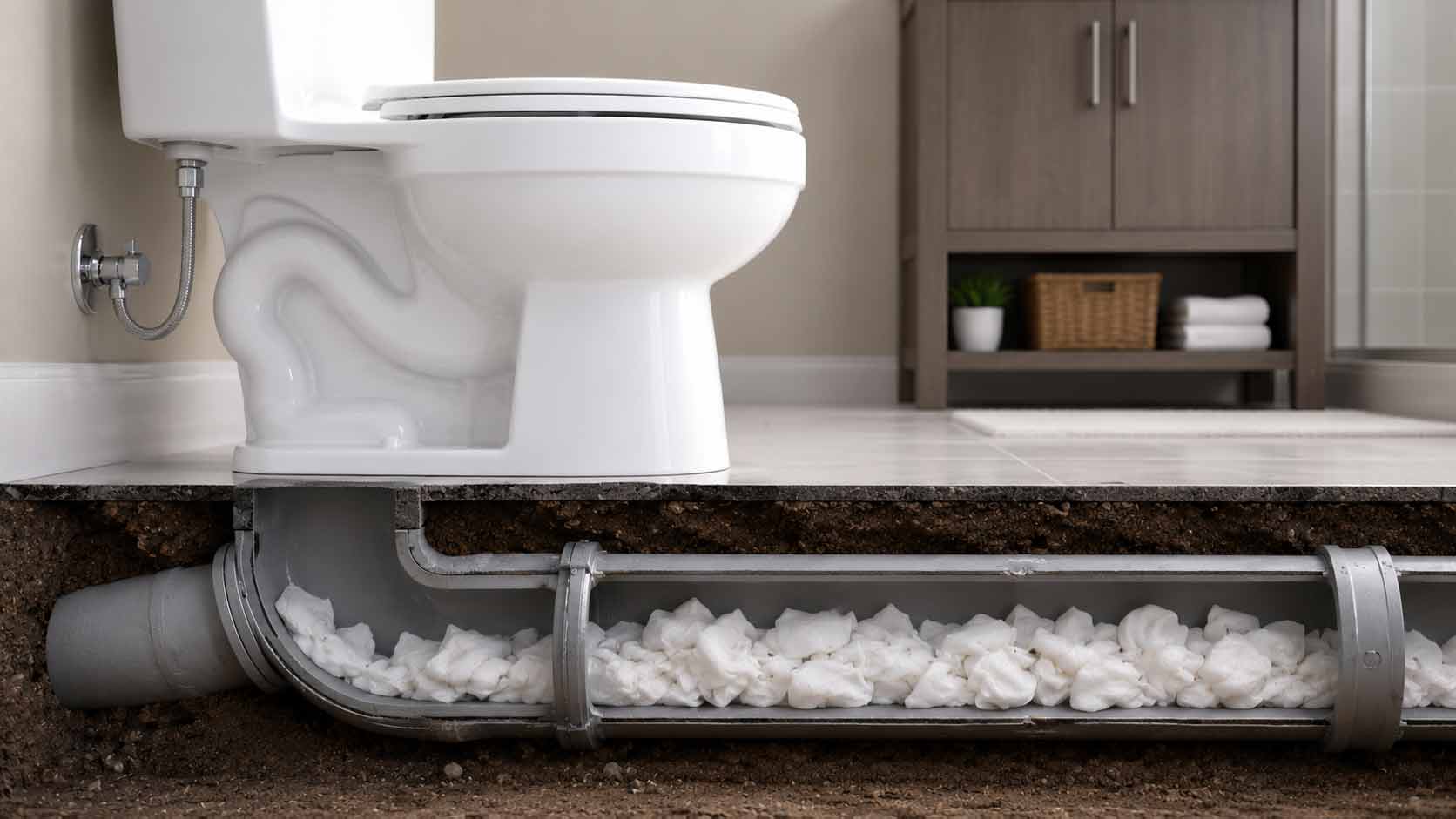
You use a wipe.
You drop it in the toilet.
You flush.
It disappears.
So it must be flushable, right?
Not necessarily.
Getting through the toilet is only the beginning of a much longer trip through your home’s plumbing.
Toilet paper is designed to lose its structure quickly after it gets wet. Many wipes are designed to do almost the opposite — stay strong while they’re wet.
That difference can become a serious problem inside a Houston sewer line.
Here’s what homeowners should know before another “flushable” wipe goes down the toilet.
## Flushable Doesn’t Mean the Same Thing as Toilet Paper
The confusion starts with the word flushable.
A product may physically travel through the toilet trap and disappear from the bowl.
That doesn’t necessarily mean it will move cleanly through:
- The bathroom drain
- Branch drain lines
- Your main sewer lateral
- Older or damaged pipes
- The municipal wastewater system
Toilet paper is specifically designed to break apart rapidly in water.
Wipes need enough strength to stay together while you’re using them.
That’s useful when they’re in your hand.
It’s not so useful when they’re traveling through your plumbing.
## Why Wipes Cause Problems Inside Sewer Lines
One wipe doesn’t necessarily create a complete blockage the first time you flush it.
The bigger problem is what happens after it enters the pipe.
Imagine a sewer line that already has a small rough spot inside.
Maybe there’s:
- Corrosion
- Heavy scale
- A separated joint
- Tree roots
- Grease buildup
- A partially damaged pipe
- Another piece of debris
A wipe can catch on that obstruction.
The next wipe catches on the first one.
Then toilet paper and waste begin collecting around them.
Eventually, what started as a small restriction becomes a much larger blockage.
Water may still squeeze past it for a while, which is why homeowners often notice slow drains before they experience a complete sewer backup.
## Houston Has a Wipes and Grease Problem
Houston Public Works specifically warns residents about wipes, fats, oils, and grease entering the sewer system.
These materials can accumulate inside sewer lines and contribute to serious blockages.
And the problem doesn’t begin at the city sewer.
Everything you flush has to travel through your home’s private sewer line first.
A combination of wipes and grease can be particularly troublesome.
Grease coats the inside of a drain.
Wipes catch on that buildup.
More material collects.
The opening becomes smaller.
Eventually, wastewater has nowhere to go.
And when wastewater can’t travel toward the street, it starts looking for another exit.
Sometimes that exit is your shower or bathtub.
## What Should Actually Go Down Your Toilet?
The rule is surprisingly simple.
Your toilet is designed primarily for:
Human waste and toilet paper.
That’s it.
Products that should normally go into the trash include:
- Baby wipes
- Cleaning wipes
- Makeup-removal wipes
- Paper towels
- Facial tissues
- Feminine hygiene products
- Cotton swabs
- Dental floss
- Diapers
- Disposable cleaning cloths
Even if the package says flushable, putting the wipe in the trash is the safer choice for your plumbing.
## “But I’ve Been Flushing Them for Years”
We hear versions of this argument with a lot of plumbing problems.
“I’ve always done it this way.”
And sometimes that’s true.
Your plumbing may tolerate something for years before symptoms appear.
That’s because sewer blockages often develop gradually.
A pipe might originally have a clear interior.
Then scale develops.
Grease accumulates.
A joint shifts.
A tree root finds a tiny opening.
Now there’s something for wipes to catch on.
The fact that your toilet successfully flushed hundreds of wipes doesn’t mean the next one can’t become part of the blockage that finally stops the line.
## Five Signs Your Main Sewer Line May Be Getting Clogged
A sewer blockage often gives you warning signs before the worst-case scenario.
Here’s what to watch for.
-
Multiple drains are slow. One slow sink usually points to a localized problem. Several slow fixtures can indicate a restriction farther downstream.
-
The toilet gurgles when another fixture drains. Run the shower and the toilet bubbles. Drain the bathtub and the toilet gurgles. Water and air may be struggling to move through a partially blocked drainage system.
-
Water comes up through the bathtub or shower. Flush a toilet and water appears in the tub, or run the washing machine and the shower drain backs up. That’s a major warning sign of a downstream blockage.
-
The same problem keeps returning. You clear the drain, everything works, and a few weeks later it’s clogged again. At that point, the clog may be a symptom rather than the underlying problem.
-
Sewage backs up into the house. Stop using water immediately. Don’t flush another toilet, start the dishwasher, run the washing machine, or take a shower.
Our guide to the 7 warning signs of a 7 warning signs of a sewer line problem in your Houston home covers the other symptoms homeowners should know.
## Is It Just the Toilet or the Main Sewer Line?
This distinction matters.
If one toilet is clogged and every other fixture works normally, the blockage may be inside the toilet trap or the drain immediately below it.
That’s often a localized plumbing problem.
But suppose:
- Two toilets are affected
- The bathtub is backing up
- Several drains are slow
- The toilet gurgles when you use another fixture
Now you’re seeing symptoms across the drainage system.
That points farther downstream.
The main sewer line should be considered.
## Can a Plunger Fix It?
For a simple toilet clog, absolutely.
A good toilet plunger can clear many localized obstructions.
But a plunger has limits.
If wipes have traveled deeper into the drainage system and combined with grease, roots, or other debris, plunging the toilet isn’t going to clean the main sewer line.
If multiple fixtures are affected, stop treating it like a simple toilet clog.
## What About Chemical Drain Cleaners?
Chemical drain cleaner wouldn’t be our first move for a suspected sewer blockage.
Why?
Because you still don’t know what’s actually blocking the pipe.
Chemicals don’t repair:
- Broken sewer pipe
- Root intrusion
- Separated joints
- Collapsed sections
- Heavy physical obstructions
And if the line remains blocked, now there’s potentially an aggressive chemical sitting inside the pipe that someone has to work around.
For recurring or main-line problems, identifying the obstruction is more useful than pouring another product down the drain.
## How a Plumber Clears a Wipe Blockage
The correct approach depends on where the blockage is and what’s causing it.
Professional drain cleaning equipment can reach much farther into the drainage system than a household plunger or small hand snake.
The immediate goal is to restore proper flow through the pipe.
But if this isn’t the first time the sewer has clogged, there’s another question we need to answer:
Why does material keep getting stuck there?
That’s where inspection becomes important.
## Why a Sewer Camera Matters
Imagine we clear a large mass of wipes from your sewer line.
Problem solved?
Maybe.
But suppose those wipes were catching on tree roots growing through a damaged joint.
Or a badly corroded section of pipe.
Or a section that has shifted.
The wipes were part of the blockage.
They weren’t necessarily the original problem.
A sewer camera can help inspect the inside of the line and look for:
- Root intrusion
- Cracks
- Separated joints
- Corrosion
- Heavy buildup
- Damaged pipe
- Recurring obstruction points
That’s particularly useful when a homeowner has experienced the same sewer problem more than once.
If your property has mature trees, read our guide to tree roots in Houston sewer lines to understand how roots enter damaged underground pipes.
## Wipes + Grease + Roots: A Bad Combination
A healthy, smooth sewer line gives waste fewer places to catch.
An older or damaged sewer line is different.
Now combine:
Grease coating the pipe
Tree roots entering a joint
Wipes that don’t break apart quickly
You have almost everything needed to build a serious obstruction.
That’s why recurring drain problems should be diagnosed instead of repeatedly cleared.
## How to Prevent Wipe-Related Sewer Problems
The easiest plumbing repair is the one you never need.
Keep a small trash can beside every toilet in the house.
Then make one family rule:
Wipes go in the trash.
Not just baby wipes.
Not just cleaning wipes.
All wipes.
Also avoid sending cooking fats, oils, and grease down the kitchen sink.
Small habits can make a big difference inside your drainage system.
And they’re much easier than dealing with wastewater coming through the bathtub.
## When to Call a Houston Plumber
Call a plumber when:
- Multiple fixtures are backing up
- Several drains suddenly become slow
- Your toilets gurgle when another fixture drains
- The same sewer clog keeps returning
- Wastewater appears in a bathtub or shower
- A plunger clears the problem only temporarily
- You suspect roots or damage inside the sewer line
A recurring sewer problem deserves more than another temporary fix.
The goal should be finding out why the line keeps clogging.
## How Hugo Plumbing Can Help
We’ve spent more than 20 years helping Houston homeowners deal with clogged drains, sewer backups, damaged sewer lines, and the things people accidentally send down their plumbing.
If your toilet keeps clogging, several drains are moving slowly, or wastewater is backing up into your home, we can help determine whether you’re dealing with a simple localized clog or a larger sewer problem.
Depending on what we find, the solution may involve:
- Professional drain cleaning
- Sewer line inspection
- Locating the blockage
- Removing the obstruction
- Sewer line repair
- Sewer line replacement
- Trenchless sewer repair when appropriate
The right solution depends on what’s actually happening inside the pipe.
We’d rather find the cause than keep clearing the same clog.
## Frequently Asked Questions
Are flushable wipes actually safe to flush?
The safest answer is no. Flushable wipes may pass through the toilet, but they don’t break apart as quickly as toilet paper. They can catch on grease, roots, rough pipe surfaces, or other debris and contribute to a blockage.
What should you flush down a toilet?
Human waste and toilet paper are what residential toilets and sewer systems are designed to handle. Wipes, paper towels, feminine hygiene products, cotton swabs, dental floss, diapers, and similar products belong in the trash.
Can flushable wipes clog a main sewer line?
Yes. Wipes can combine with grease, waste, roots, and other material inside a sewer line. Over time, that accumulation can restrict flow and contribute to recurring clogs or sewage backups.
How do I know if wipes are clogging my sewer line?
Multiple slow drains, gurgling toilets, recurring main-line clogs, and wastewater backing up into showers or bathtubs are common warning signs. If the problem keeps returning, inspecting the sewer line can help identify the actual cause.
What should I do if my toilet backs up after flushing wipes?
Stop flushing. If other drains or fixtures are also affected, limit water use throughout the house because the problem may be in the main sewer line rather than the toilet itself.
## If It Doesn’t Break Down, Don’t Flush It
The word flushable can be misleading.
The real question isn’t whether your toilet can make something disappear.
It’s whether that material can travel through the entire sewer system without contributing to a blockage.
With wipes, that’s a gamble your plumbing doesn’t need.
If you’ve got gurgling toilets, multiple slow drains, or a sewer problem that keeps coming back, give Hugo Plumbing a call before a slow drain becomes a sewage backup.
Call or text (713) 409-7176 for a free estimate and a written price.
If your drain won’t go, call Hugo.
Explore Our Plumbing Services
See all plumbing services, the areas we serve, or more plumbing tips.