
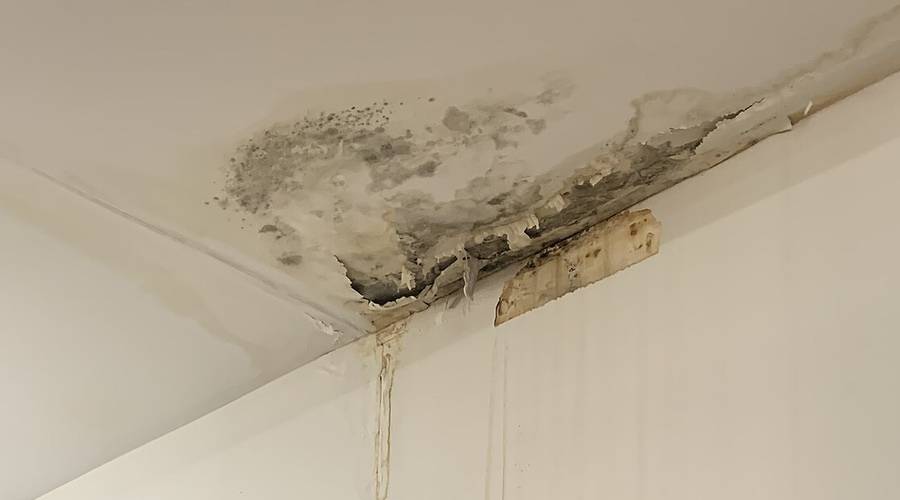
It’s 98 degrees, it hasn’t rained in two weeks, and there’s a wet brown ring spreading across your hallway ceiling. Most Houston homeowners’ first thought is the roof. It’s almost never the roof. In August, a ceiling stain on a clear day is usually your air conditioner quietly flooding your attic through a clogged drain line — one of the most common calls we take all summer, and one of the cheapest problems to fix if you catch it in the first day or two.
Here’s what’s actually happening up there, how to spot it early, and what you can do about it before the drywall comes down.
Your AC Is Also a Dehumidifier
Air conditioning doesn’t just cool air — it wrings the water out of it. Warm, humid air passes over a cold evaporator coil, moisture condenses on the coil the same way it beads on a glass of iced tea, and that water drips into a pan underneath.
In a dry climate that’s a trickle. On the Gulf Coast in August, with dew points in the 70s, a typical home’s system can pull 10 to 20 gallons of water out of the air every single day. All of it has to go somewhere, and the only thing standing between that water and your ceiling is a skinny PVC pipe about three-quarters of an inch across.
That pipe is called the condensate drain line. It runs from the drain pan, usually through the attic, and terminates either outside near your condenser, over a soffit, or — very commonly in Houston — tied into your home’s plumbing drain system.
Why Houston Homes Get Hit Hardest
Three things stack against us here.
We’re slab-on-grade. No basements means the air handler goes in the attic, directly above your finished living space. In a home with a basement furnace, a drain overflow makes a puddle on a concrete floor. Here, it makes a ceiling.
The humidity never lets up. More moisture in the air means more condensate, which means the line runs wet nearly around the clock for five straight months. A line that’s damp all summer is a line that grows things.
Attics hit 130 degrees. A warm, wet, dark pipe is an ideal environment for algae and biofilm — the slimy stuff that actually causes most of these clogs. Add attic dust and insulation fibers bonding to that slime and you get a plug that sets up like soft cement.
Seven Warning Signs, Roughly In Order
You usually get several days of warning before the ceiling gives up. Here’s what to watch for.
- Water stains or a soft spot on the ceiling — most often in a hallway, closet, or laundry room, because that’s where the attic access and air handler tend to sit. A stain that grows on hot days and stops on cool ones is a condensate leak, not a roof leak.
- Dripping from the soffit or over a window. Many attic units have a secondary drain pan with its own emergency line that discharges somewhere obvious on purpose. If you see water dripping from an eave on a dry day, that’s not a mystery — it’s your system’s alarm going off. The primary line is already clogged and the backup is doing the work.
- Your AC shuts itself off on a hot afternoon. A float switch in the pan cuts power when the water rises. It’s the system protecting your house. Reset it without clearing the clog and you’re just restarting the flood.
- A musty smell when the air kicks on. Standing water in the pan grows mold and algae, and your return air pulls that smell straight into the house.
- Standing water in the drain pan. If you can safely see the air handler, look at the pan. It should be essentially dry while running. Water sitting in it means the line isn’t carrying it away.
- Gurgling from a nearby sink or tub. This one matters. If the AC line ties into your plumbing and you’re hearing gurgles or seeing slow drains elsewhere, the clog may not be in the AC line at all — it’s downstream in the plumbing, and the AC is just the first fixture to complain.
- A water bill that crept up for no reason. Less common, but worth ruling out. Condensate is water you already paid for; a genuinely rising bill usually means something else. Our guide to an unexplained high water bill walks through the ten-minute meter test.
What Actually Causes the Clog
- Algae and biofilm. By a wide margin the number one cause. Slime builds on the inside of the line all summer until flow stops.
- Dust, drywall grit, and insulation. Attic debris gets pulled into the pan and binds to the slime.
- A sagging or flat line. Condensate drains entirely by gravity. If the PVC has sagged between hangers over the years, water pools in the low spot and sediment settles there. This is why some homes clog every single summer while their neighbors never do.
- A dry or missing trap. The line should have a P-trap. Without one, the air handler’s own suction can hold water in the line instead of letting it drain.
- A problem in the plumbing drain downstream. If the condensate ties into a lavatory drain or branch line that’s fouled with hair, grease, or scale, the AC line backs up even though the AC line itself is perfectly clean. Houston’s hard water doesn’t help here — scale narrows those small branch drains over time.
The 20-Minute DIY Fix
If you’ve caught it early, there’s a good chance you can clear this yourself.
- Turn the system off at the thermostat. Don’t work on a running unit.
- Find where the line discharges outside. Look for a white PVC stub near the outdoor condenser unit or poking through an exterior wall, usually a foot or so off the ground.
- Put a wet/dry vacuum on it. Hold the hose tight against the pipe — wrap a rag around the joint to seal it — and run it for two to three minutes. You’re pulling the plug out from the easy side. When it lets go, you’ll get a slug of nasty water into the vac. That’s success.
- Clear the pan. Sop up any standing water in the drain pan with a shop vac or towels so it isn’t sitting there growing more slime.
- Treat the line. Find the access tee near the air handler — a capped T-fitting on the drain line — and pour in about a cup of distilled white vinegar. It kills the algae without corroding the metal pan and coil the way bleach does. Do this monthly through the summer and you’ll likely never see this problem again.
- Reset the float switch if one tripped, and turn the system back on. Confirm water is running out of the discharge line within a few minutes.
If the vacuum doesn’t pull anything and water still won’t drain, stop. Blowing compressed air backward into the line is a good way to blow a joint apart inside the attic and turn a $200 problem into a drywall project.
When to Call a Plumber Instead
Call us when the DIY pass doesn’t take, or when the symptoms point past the AC:
- The line clears but backs up again within days or weeks. That’s a sagging line, a bad trap, or a downstream problem — the clog is a symptom, not the cause.
- Other drains in the house are slow or gurgling. The condensate line is tied into your plumbing and the real blockage is in the branch. That needs professional drain cleaning, not a shop vac.
- The ceiling is already wet, stained, or sagging. At that point you have two problems, and the water needs to stop today.
- You can’t find the discharge line at all. In some homes it’s tied in entirely inside the walls, and there’s nothing to vacuum.
- You’re not certain the water is condensate. A supply line weeping in the attic, a failing water heater in an attic closet, or a leak in a pressurized line all produce a ceiling stain too — and those don’t stop when you shut off the AC. If you’re unsure, leak detection settles it without opening up the ceiling.
A useful home test: shut the AC off for a few hours. If the dripping stops, it’s condensate. If it keeps going, it’s a pressurized water line, and that’s an emergency call — go find your main shutoff valve now, not later.
How Hugo Plumbing Can Help
We’ve spent 20+ years in Houston attics, and we’ve seen every version of this — the line that clogs like clockwork every July, the “roof leak” that turned out to be a condensate pan, the AC drain that was fine all along while a grease-packed kitchen branch downstream was the actual problem. We clear the line properly, camera and snake the plumbing drain it ties into when that’s where the trouble really is, correct sagging pipe and missing traps so it stops happening every year, and tell you plainly when the fix belongs to your HVAC company instead of us. No upsell on a repair you don’t need.
Frequently Asked Questions
Why is water dripping from my ceiling when it hasn’t rained? In a Houston summer, the most likely culprit is your air conditioner’s condensate drain line. Your AC pulls gallons of water out of the humid air every day, and that water drains away through a small PVC line. When the line clogs, the drain pan overflows, and if your air handler is in the attic, that water comes through the ceiling below. It looks exactly like a roof leak, but it happens on clear, hot days instead of rainy ones.
Can I unclog my AC drain line myself? Often, yes. Find where the drain line exits your house (usually a white PVC pipe near the outdoor condenser or along an exterior wall) and hold a wet/dry vacuum tightly over the end for two or three minutes. That pulls the slime clog out from the discharge side. Then pour a cup of distilled white vinegar into the access tee near the air handler to keep it from growing back. If the water still won’t drain after that, the blockage is deeper in the line or in the plumbing drain it ties into.
Should I pour bleach down my AC drain line? We’d use vinegar instead. Bleach is effective on the slime, but it corrodes the metal drain pan, coil, and any metal fittings it sits against, and many equipment manufacturers specifically advise against it. Distilled white vinegar kills the same algae and biofilm without eating your equipment. Either way, never mix the two.
Why did my AC shut itself off in the middle of the day? Most modern systems have a float switch in the drain pan or drain line. When water backs up, the float rises and cuts power to the AC on purpose. It’s the equipment protecting your ceiling from thousands of dollars of water damage. If your AC quits on a hot afternoon with no other symptoms, check the drain pan before you assume the unit failed. Resetting the switch without clearing the clog just restarts the flood.
Is a clogged AC drain a plumbing problem or an HVAC problem? It can be either, which is why it gets misdiagnosed so often. The pan and the coil belong to your HVAC system, but the condensate line itself is a drain, and in most Houston homes it ties into the house’s plumbing drain system. If your AC line and a nearby sink or tub are both draining slowly, the clog isn’t in the AC at all; it’s in the plumbing branch downstream, and that’s a plumber’s call.
Don’t Wait for the Ceiling
A condensate clog is one of the few plumbing problems that gives you plenty of warning and costs almost nothing to prevent. A cup of vinegar down the access tee once a month all summer, and a quick look at the drain pan when you change your filter, is the whole program. It’s the ignored version — the one that runs for a week into the insulation — that turns into stained drywall, ruined ceiling joists, and a mold remediation bill.
Call or text (713) 409-7176 for a free estimate and a written price.
If you’ve got a stain spreading, an AC that keeps shutting itself off, or a drain line that clogs every single July, give us a call and we’ll get to the bottom of it. If your drain won’t go, call Hugo.
Explore Our Plumbing Services
See all plumbing services, the areas we serve, or more plumbing tips.