
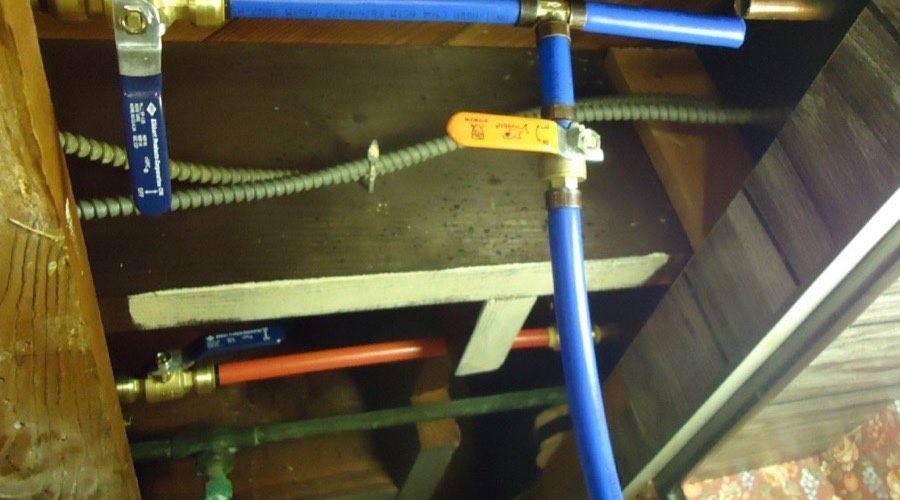
If you’ve been told your Houston home needs a repipe — because of repeated pinhole leaks, rusty water, gray polybutylene pipe behind the walls, or a slab leak that’s the third in five years — the next question is what to replace it with. Two materials dominate: PEX (cross-linked polyethylene, the flexible red-and-blue tubing) and copper. Both are code-approved and both can last decades. Here’s how they compare specifically for Houston conditions, and what we recommend.
Quick Comparison
| PEX | Copper | |
|---|---|---|
| Material cost | Lower | Higher (and volatile) |
| Labor / install time | Faster — flexible, fewer fittings, fewer wall openings | Slower — rigid, soldered or pressed joints, more access cuts |
| Expected lifespan | 50+ years (rated); in wide use since the 1990s | 50–70 years in good water; less in aggressive water |
| Houston water chemistry | Unaffected | Prone to pinhole corrosion |
| Attic heat and freeze | Flexes with expansion; tolerates freezing better | Rigid; bursts when frozen |
| Sunlight (UV) | Must be protected | Unaffected |
| Rodents | Can be chewed if exposed | Not an issue |
| Noise | Quiet; damps water hammer | Can transmit hammer and expansion ticking |
| Fittings | Expansion or crimp rings; fewer joints overall | Soldered, pressed, or compression |
Why Houston Is Different
Water chemistry eats copper
Houston’s water is moderately hard, and the pH and dissolved oxygen levels in parts of the system are aggressive toward copper. The result is pinhole leaks — tiny pits that corrode from the inside out, often in multiple places within a few years of each other. If you already have pinholes in your existing copper, replacing it with more copper means starting the clock again in the same water. PEX doesn’t corrode.
Learn more about what our water does to plumbing in Houston hard water and how it damages your plumbing.
Slab foundations mean attic runs
Most Houston homes sit on a slab, so a repipe reroutes supply lines through the attic and down the walls rather than under the floor. Houston attics hit 130°F+ in summer and, every few winters, drop below freezing. PEX expands and contracts with those swings without stressing its joints and tolerates a freeze far better than copper — a lesson thousands of Houston homeowners learned in February 2021, when frozen copper split and PEX mostly didn’t. Our frozen and burst pipe guide covers what to do if it happens again.
Fewer holes in your walls
Because PEX bends, a repipe crew can pull a continuous run from a manifold or trunk line to each fixture with a fraction of the drywall openings copper requires. That saves labor and saves the drywall repair bill afterward.
Where Copper Still Wins
- Exposed runs. Anywhere pipe sees sunlight — an exterior hose bibb stub, a pool equipment pad — copper (or protected PEX) is the right call. UV degrades unprotected PEX.
- Rodent-prone spaces. Rats and squirrels will chew PEX in an attic they’ve colonized. If you have a rodent problem, fix it first or use copper on exposed sections.
- Certain commercial and high-temperature applications, and recirculation loops that run near PEX’s temperature limits.
- Preference and resale. Some buyers and inspectors still expect copper. It’s a legitimate reason, if a more expensive one.
Copper is a great material; it’s just not the best match for a typical Houston slab home’s attic and water.
PEX Done Right vs. PEX Done Cheap
Almost every PEX failure story comes down to the install, not the material:
- Fittings. Expansion (Uponor-style) or properly crimped copper-ring fittings from the same manufacturer as the tubing. Not mixed brands, not push-fit connectors buried in walls.
- Support and protection. Sleeved where it passes through slabs or masonry, protected from UV at penetrations, kept away from recessed-light housings and flue pipes in the attic.
- A manifold or a well-designed trunk-and-branch layout with a labeled shutoff for each fixture, so a future repair doesn’t require shutting off the whole house.
- Pressure test and inspection before the walls are closed.
What About the Old Pipe?
If you’re repiping because of polybutylene (the gray pipe installed in many Houston homes from the late 1970s through the mid-1990s) or galvanized steel (typical before 1970), the answer is a full replacement — those materials fail from the inside and can’t be reliably patched. The signs are covered in Signs you need to repipe your Houston home. We abandon the old lines in place and route new ones; the old pipe is cut and capped, not left pressurized.
What a Repipe Costs and How Long It Takes
Repipe pricing depends on square footage, stories, fixture count, material, and how much wall has to be opened, so we quote it after a free walkthrough rather than over the phone. PEX comes in lower than copper on both material and labor. Most single-family Houston repipes take two to five working days, with water back on each evening. Our $300 repipe coupon applies to water or gas repipes, and the full scope and price are in writing before we start. Details on the service are on our repiping page.
Typical Houston-area ranges
These are general market ranges as of September 2026, not Hugo Plumbing prices; see the full breakdown in our repipe cost guide.
| Home | PEX repipe (Houston-area market range) | Copper repipe (market range) |
|---|---|---|
| Small single-story, 1–1.5 baths | roughly $4,000–$7,000 | roughly $7,000–$11,000 |
| Mid-size single-story, 2–2.5 baths | roughly $6,000–$10,000 | roughly $10,000–$16,000 |
| Two-story, 3+ baths | roughly $9,000–$15,000+ | roughly $15,000–$25,000+ |
Drywall repair, paint, and any slab or tunneling work for under-slab lines are extra with either material. The gap between the columns is the material (copper is priced by commodity markets and has swung widely) plus labor: a soldered or pressed copper joint at every turn versus a continuous PEX pull with a fitting only at each end.
Our Recommendation
For the typical Houston home — slab foundation, attic supply runs, city water — PEX is the better repipe material, installed with matched expansion or crimp fittings, a manifold or labeled trunk layout, and full protection from UV and heat sources. Choose copper where pipe is exposed to sun or rodents, or because you prefer it and understand the cost. Either way, a repipe is a 50-year decision; get a licensed plumber’s walkthrough, a written price, and a pressure test before the drywall goes back up.
Frequently Asked Questions
Is PEX or copper better for a repipe in Houston?
For most Houston homes, PEX. It handles the attic heat cycles and rare hard freezes better than rigid copper, it is not affected by the mineral content or pH swings in Houston water that cause pinhole leaks in copper, it can be run through a slab-on-grade home with far fewer wall openings, and it costs less. Copper still makes sense where pipe will be exposed to sunlight or rodents, in some commercial applications, or when a homeowner simply prefers it.
How long does PEX last compared to copper?
Copper has a proven track record of 50 to 70 years in good water conditions, though Houston’s water chemistry can shorten that with pinhole corrosion. Modern PEX is rated for 50 years and has been in wide U.S. use since the 1990s; the main failure points are cheap fittings and sun exposure, both of which a proper installation avoids.
How much does it cost to repipe a house in Houston?
It depends on square footage, number of bathrooms and fixtures, one or two stories, pipe material, and how much drywall has to be opened and repaired. PEX repipes generally cost less than copper because the material is cheaper and installs faster. Hugo Plumbing prices repipes after a free walkthrough and quotes the exact number in writing; our $300 repipe coupon applies to gas or water repipes.
How long does a whole-home repipe take?
Most single-family repipes in Houston take two to five days of plumbing work. Water is typically off only during working hours and turned back on each evening. Drywall repair by a separate contractor adds time after the plumbing inspection passes.
What pipe should replace polybutylene or galvanized pipe?
PEX in nearly every case. Polybutylene (gray pipe common in Houston homes built roughly 1978 to 1995) and galvanized steel (common before 1970) both fail from the inside and should be replaced entirely rather than patched. PEX with expansion or crimp fittings is the standard replacement for both.
How much more does a copper repipe cost than PEX in Houston?
As of September 2026, Houston-area PEX repipes commonly run about $4,000 to $7,000 for a small single-story home, $6,000 to $10,000 for a mid-size single-story, and $9,000 to $15,000 or more for a two-story with three or more baths. Copper repipes on the same homes commonly run roughly $7,000 to $11,000, $10,000 to $16,000, and $15,000 to $25,000 or more, because copper costs more per foot and takes longer to install with more wall openings. These are market ranges, not Hugo Plumbing prices; we quote the exact number in writing after a free walkthrough.
Is PEX safe for drinking water and does it affect taste?
Yes. PEX is certified for potable water under the same standards as copper, and it has been installed in U.S. homes since the 1990s. Some homeowners notice a faint plastic taste in the first weeks after a new PEX install, which flushes out; copper can impart a metallic taste when water sits in it, particularly in the aggressive water chemistry found in parts of Houston that causes pinholes.
Call or text (713) 409-7176 for a free estimate and a written price.
If your pipes won’t hold, call Hugo.
Explore Our Plumbing Services
See all plumbing services, the areas we serve, or more plumbing tips.